How to Plan a Back-to-School Neighborhood Carpool Kickoff Party (Without Losing Your Mind)
The August Panic Is Real
It's the third week of August. Your phone is blowing up with texts from four different neighbors — all asking some version of the same question: 'So, are we doing carpool again this year?' You've got one parent who can only do Tuesdays and Thursdays, another who needs to leave by 7:42 AM sharp, a new family on the block who just moved in and doesn't know anyone yet, and a group chat that has somehow devolved into a debate about whether Karen's minivan counts as a 'seven-seater' if the third row is permanently folded down.
Sound familiar? Every August, millions of parents across the country face the same logistical puzzle: how do you coordinate a neighborhood carpool that actually works — and do it before the first bell rings? The answer, increasingly, is to stop texting in circles and start with a real kickoff event. A Back-to-School Carpool Kickoff Party isn't just a fun excuse to eat snacks on someone's lawn. It's a structured, intentional gathering that gets everyone aligned, builds trust between families, and sets your carpool up for a drama-free school year.
Here's exactly how to pull it off — even if you have two weeks, a packed schedule, and zero party-planning experience.
Why a Kickoff Party Works Better Than a Group Chat
Group chats are great for quick updates. They're terrible for making complex decisions with multiple stakeholders. When you're coordinating schedules, car assignments, backup plans, and house rules across six families, a text thread quickly becomes a wall of noise. People misread tone. Important details get buried. And the loudest voice tends to 'win,' even if their plan doesn't work for everyone.
A face-to-face kickoff party solves all of this. It gives parents a dedicated time and space to:
- Meet new neighbors and build rapport before they're trusting each other with their kids
- Work through scheduling conflicts in real time, with everyone present
- Agree on shared rules and expectations (pickup times, behavior standards, sick-day protocols)
- Walk away with a written, confirmed schedule — not a half-finished thread of 'sounds good to me!' replies
Think of it less like a party and more like a productive team meeting that happens to have lemonade and a cheese board.
Step 1: Send a Real Invitation (Not Just Another Text)
The first signal you send about this gathering is the invitation itself. If you fire off a casual 'Hey everyone, come over Saturday at 4?' in the group chat, you'll get casual responses — or no responses at all. Instead, send a proper invitation that communicates: this is organized, this matters, and we're actually going to get things done.
A clean, clear digital invite does exactly that. Platforms like RSVPlinks let you create a polished event invitation in minutes — complete with RSVP tracking, so you know exactly who's coming and can plan accordingly. No more 'I think six families said yes? Or was it five?' When parents see a real invitation with a confirmed date, a clear agenda, and an easy RSVP button, they take it seriously. And they actually respond.
What to include in your invitation:
- Date, time, and location (backyard, driveway, or a nearby park all work great)
- A one-line explanation: 'We're getting our carpool organized before school starts — 90 minutes, snacks provided'
- A request to bring their school schedule or a photo of it
- An RSVP deadline at least five days before the event
Step 2: Set a Clear Agenda Before Anyone Arrives
The difference between a productive kickoff and a two-hour hangout that accomplishes nothing is a written agenda. You don't need anything fancy — a printed half-sheet or even a whiteboard works perfectly. The key is that everyone knows what you're there to decide, and in what order.
A simple 90-minute agenda:
- 0:00–0:20 — Introductions and icebreaker. Go around the group: name, kids' names and grades, and one thing you're hoping carpool will solve for your family this year. This surfaces priorities fast and builds empathy.
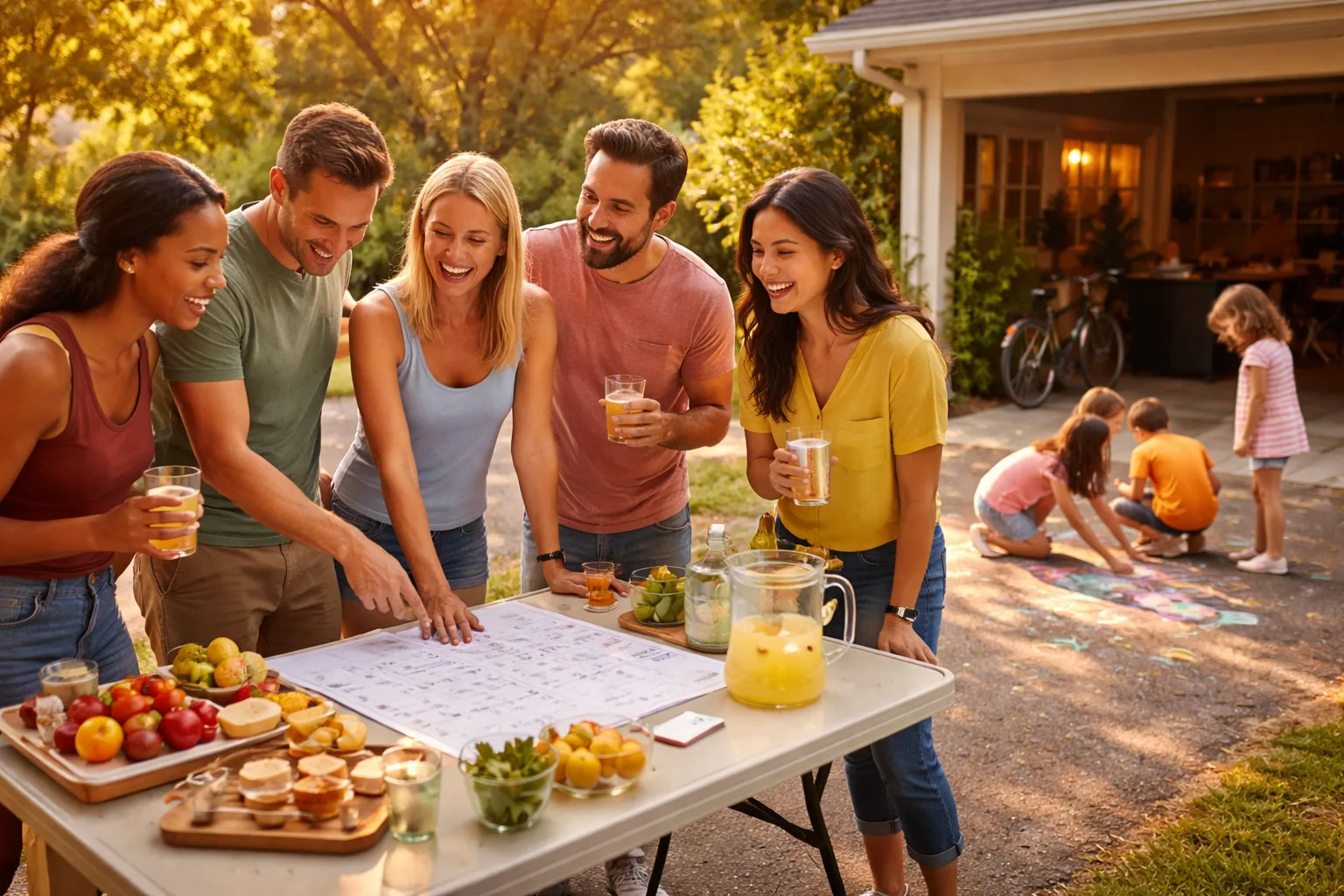
- 0:20–0:50 — Schedule mapping. Lay out everyone's availability. Use a large printed calendar or a shared whiteboard. Identify who can drive which days, who needs to be picked up first, and where the gaps are.
- 0:50–1:10 — Rules and expectations. Agree on the non-negotiables: pickup time buffer (are we waiting 3 minutes or 5?), what happens when someone is sick, phone-free driving rules, and how kids should behave in the car.
- 1:10–1:30 — Confirm the schedule and celebrate. Write it down, photograph it, share it. Then relax and enjoy the snacks — you've earned it.
Step 3: Make It Feel Like a Party, Not a PTA Meeting
Yes, you have a serious agenda. But the social glue matters just as much as the logistics. Parents who feel comfortable with each other communicate better, give each other more grace when things go sideways, and are more likely to help out in a pinch. A few small touches go a long way:
- Involve the kids briefly. Let the children meet each other for 15–20 minutes at the start — set up a sprinkler or a sidewalk chalk station. Happy kids playing together is the best possible advertisement for why this carpool is worth the effort.
- Keep the food simple and shareable. A cooler of drinks, a fruit tray, some chips and dip. This isn't a dinner party. The food is there to signal 'you're welcome here,' not to impress anyone.
- Create a 'carpool contract' moment. When you finalize the schedule, make it a little ceremonial — have everyone sign a printed copy or take a group photo with the whiteboard. It sounds cheesy, but it creates a sense of shared commitment that a Google Doc just doesn't replicate.
Step 4: Lock In the Details Before Everyone Leaves
The biggest mistake carpool organizers make is ending the party with a vague 'I'll send everything out this week.' Life happens. That follow-up email becomes a three-week saga. Before the last parent walks out the door, confirm three things:
- The finalized schedule — who drives on which days, in which order, starting when.
- The communication channel — one group chat, one shared calendar, or one document. Not all three. Pick one and commit.
- The backup plan — who do you call when someone is sick or has a conflict? Designate a backup driver or a rotation now, before you need it.
If you used RSVPlinks to collect RSVPs, you already have everyone's contact information in one place — making it easy to send a post-party follow-up with the confirmed schedule, the carpool rules, and any action items.
Step 5: Handle the Awkward Stuff Head-On
Every carpool has at least one uncomfortable conversation lurking beneath the surface. The family whose car isn't quite big enough. The parent who's chronically five minutes late. The kid who's a handful in the backseat. Address these proactively during your rules discussion — not as personal callouts, but as general policies.
'What's our policy if someone is consistently running late?' is a much easier conversation to have in a group setting before school starts than a one-on-one text confrontation in October. Setting expectations together, in person, with everyone present, removes the personal sting and creates shared accountability.
Conclusion: Three Things You Can Do Today
You don't need a party-planning background or a free weekend to pull this off. Here's where to start right now:
- Send the invitation today. Create a simple, trackable digital invite using a platform like RSVPlinks and send it to your neighbor group this afternoon. Set an RSVP deadline for five days from now. The act of sending a real invitation signals that this is happening — and that you're the one making it happen.
- Draft your agenda tonight. Spend 15 minutes writing out the four agenda items above, customized for your group's specific needs. Print two copies — one for you, one to post on the wall during the party.
- Identify your 'co-organizer.' Text one other parent right now and ask them to co-host with you. Having a partner means you can facilitate the discussion while they manage the food, the kids, and the whiteboard. It also means the workload doesn't all fall on one person — which is exactly the spirit a good carpool is built on.
The school year is coming whether you're ready or not. But with 90 minutes, a cheese board, and a clear plan, you can walk into September with a carpool that actually works — and a little more confidence that this year, the morning rush doesn't have to be a disaster.