Thanksgiving Seating Chart Ideas and Tips
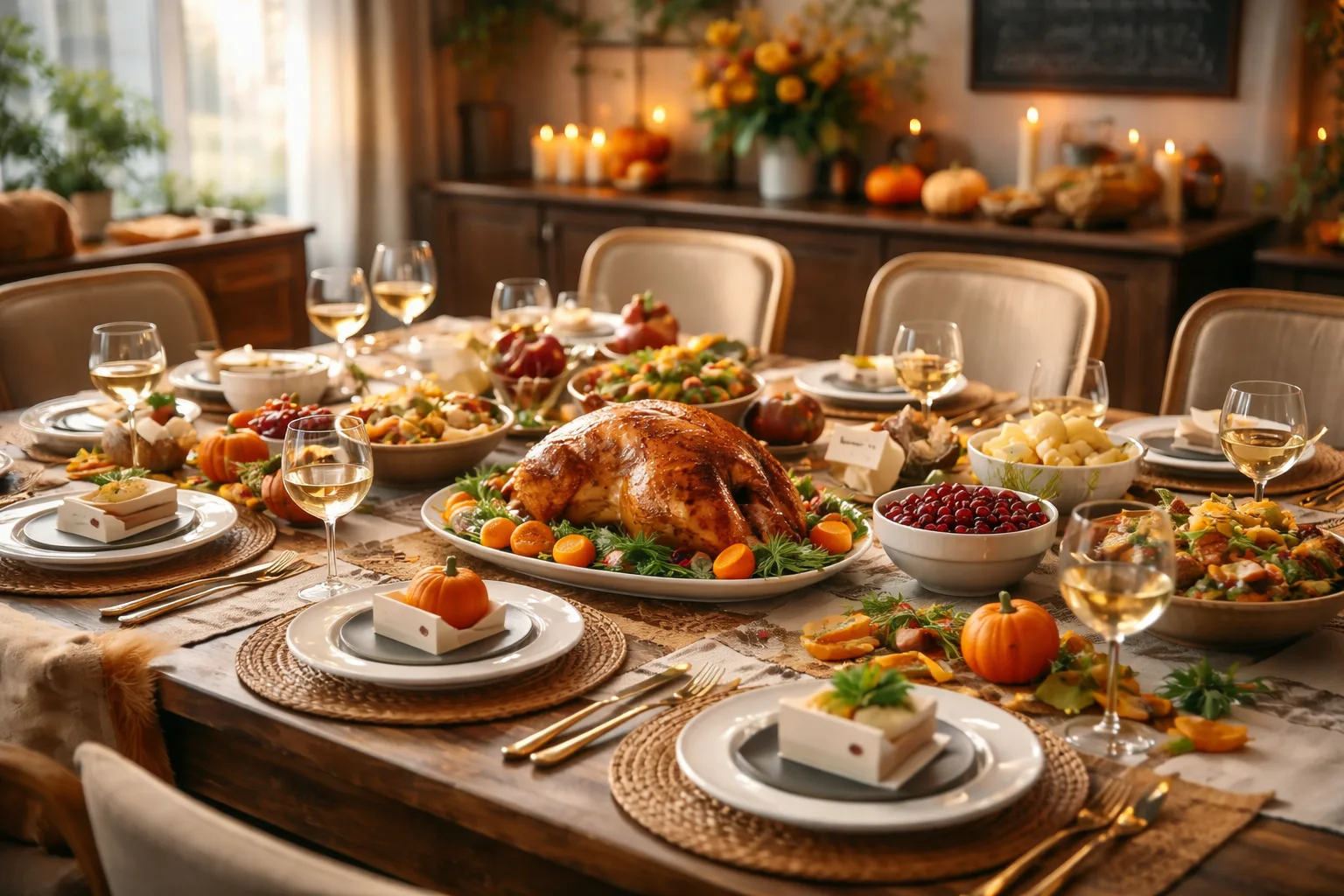
A good Thanksgiving seating chart puts the host at the end nearest the kitchen, spreads the talkers out, keeps people who clash out of each other's sightline, and gives older guests seats they can get in and out of easily. Draw it once your headcount is final: for Thanksgiving on Thursday, November 26, 2026, that means closing RSVPs by Friday, November 13 and sketching the chart the weekend of November 21–22.
Below is a timeline, the space math for tables, a set of seating arrangement rules, kids table guidance, and a sample plan for 14 guests.
Thanksgiving seating chart timeline
| Date | Task |
|---|---|
| Now through Oct 30 | Send the invitation. Ask for a headcount of adults and kids, plus dietary needs and anyone who needs an easy-access seat. |
| Fri, Nov 13 | RSVP deadline. Follow up with anyone who has not answered. |
| Sat–Sun, Nov 14–15 | Count seats. Borrow or rent tables and chairs; rental shops get busy the week of. |
| Sat–Sun, Nov 21–22 | Draw the chart. Run it past your co-host or one family member who knows the history. |
| Wed, Nov 25 | Set the tables, write place cards, keep one spare chair nearby. |
| Thu, Nov 26 | Seat everyone and let the chart do its job. |
If you are collecting replies by text, a single RSVP page with a "how many kids?" question saves you rebuilding the count from memory. This Thanksgiving dinner RSVP example shows the questions worth asking.
Count seats before you assign them
The common rule of thumb is 24 inches of table edge per person, a bit more if the table is crowded with serving dishes. Standard table sizes seat roughly:
| Table | Comfortable | Tight |
|---|---|---|
| 6-ft rectangle | 6 | 8 (one at each end) |
| 8-ft rectangle | 8 | 10 (one at each end) |
| 48-inch round | 6 | 7 |
| 60-inch round | 8 | 10 |
| Kids folding table, 4-ft | 4 kids | 6 small kids |
Pushing two tables together only works if they are the same height. A 1-inch difference catches every glass that crosses the seam. If heights differ, run them as two separate tables and seat a conversational anchor at each.
Also count legs: table legs at corners cost you the end seats on some folding tables. Sit at each spot before the day to check.
Thanksgiving seating arrangement rules that work
These are guidelines, not etiquette law. Break any of them when you know your family better.
- Host nearest the kitchen. Whoever is refilling gravy needs to get up without asking five people to scoot. The co-host or partner takes the opposite end.
- Honored guests in the middle. Grandparents or the oldest guests hear more and feel included from a center seat. Traditionally the guest of honor sits to the host's right.
- Mobility first. Anyone with a walker, a cane, or a bad knee gets an end or corner seat with a clear path to the bathroom. Parents of babies and toddlers get the same.
- Keep new partners next to their person. Etiquette books say split couples, but a first-time guest at a family Thanksgiving should sit beside the partner who brought them and across from the friendliest relative.
- Split the talkers. Put one natural conversationalist in each section of the table so the quiet end does not go silent.
- Diagonal, not across. People who do not get along should sit on the same side, several seats apart. Directly across the table is face-to-face for two hours.
- Lefties at the left end. Seat left-handed guests at the far left of a side or at a table end, where their fork elbow has open space instead of a neighbor.
- Dietary needs near their dishes. Seat the vegetarian or gluten-free guest close to the dishes they can eat so they are not passing plates the length of the table.
Thanksgiving table seating ideas
One long table
Join tables end to end, cover the seam with one long tablecloth or two overlapping ones, and seat everyone together. It is the classic look and works up to about 16 people. Past that, the two ends stop talking to each other.
Two tables with a captain each
For 16–24 guests, set two tables and give each an anchor: a grandparent at one, the host at the other. Mix generations at both instead of splitting old from young.
L-shape or T-shape
If your space is long and narrow, an L-shape through the dining room and into the living room keeps everyone in view. Put the serving buffet at the corner.
Buffet with reserved seats
For a big, casual crowd, serve buffet-style and reserve only a few seats: the oldest guests, anyone with mobility needs, and the host. Everyone else sits where they like.
Dessert swap
After dinner, ask everyone on one side to move two seats to their left for pie. It is simple, breaks up any tense pairings, and gets people talking to someone new.
Place cards with a prompt
Write a question on the back of each card: "Best Thanksgiving dish you have ever had?" It gives quiet guests an easy opener. Write names in pencil or on removable labels in case of last-minute changes.
The kids table at Thanksgiving
A kids table works well when there are five or more kids of similar ages. With three or fewer, seat them with their parents at the main table.
- Keep it in sightline. Place it next to the main table or in the doorway, not in another room.
- Set it properly. Real plates and a centerpiece tell kids they are part of dinner, not parked.
- Give them something to do. Cover the table in kraft paper with a cup of crayons and a "draw what you're thankful for" prompt.
- Pick an age cutoff and say it early. Many families move kids up around 12 or 13. The cleaner rule: once a kid asks to sit with the adults, let them.
- Seat an older cousin at the head. A teen who likes being in charge makes the kids table feel like the fun table.
- Serve kids first. Plate for them before the adults sit so parents can eat while the food is hot.
Do not send an adult without kids, or a 17-year-old who has outgrown it, to the kids table because you ran out of chairs. Borrow a chair instead.
Sample seating plan for 14
Here is one way to seat 10 adults and 4 kids with an 8-ft table plus a kids table beside it:
- Kitchen end: host.
- Host's right: Grandma, with a clear path to the hallway.
- Host's left: Uncle who carves, close to the turkey platter.
- Middle seats, both sides: alternate siblings and spouses, with the newest partner beside their person and across from the chattiest aunt.
- Corner near the kids table: the parents of the two youngest kids.
- Far end: co-host, with the two cousins in their twenties on either side.
- Kids table: four kids ages 5–11, with a 14-year-old cousin at the head if one is coming. If not, keep one parent within arm's reach.
How to make the chart
For one table of 10, a sketch on paper with sticky notes for each name is all you need. Move the notes around until nobody is stuck next to the wrong person, then snap a photo.
A digital chart helps once you are seating 25 or more across several tables, or when RSVPs are still shifting. RSVPlinks offers a drag-and-drop seating chart as a paid per-event add-on: you lay out round or rectangle tables, drag guests from your RSVP list onto them, and can share a seating page with a QR code so guests find their table without asking. Details are on the pricing page. For a single family table, paper is still fine.
Handling last-minute changes
- Surprise plus-one: the spare chair you set aside goes next to the guest who brought them.
- Last-minute cancellation: close the gap by sliding everyone on that side one seat, rather than leaving a hole in the middle.
- A flare-up: the dessert swap is your quiet fix.
If you still need firm numbers, set an RSVP deadline and send one reminder. Our guide on how to track RSVPs covers following up without a spreadsheet. When you are ready to invite everyone, create a free RSVP link and ask for adult and kid counts on the form.
Frequently Asked Questions
Where should the host sit at Thanksgiving dinner?
The host sits at the end of the table closest to the kitchen. That lets them refill dishes and check the oven without disturbing anyone. A co-host or partner usually takes the opposite end.
Should couples sit together at Thanksgiving?
For a family Thanksgiving, yes, especially when one partner is new to the family. Formal etiquette splits couples to mix conversation, but that suits dinner parties more than holidays. Longtime couples can be split if they enjoy it.
What age is too old for the kids table?
Many families move kids to the adult table around 12 or 13. The simplest rule is that once a child asks to join the adults, they are ready. Teens who like being in charge can still sit at the kids table as its head.
How much space does each person need at a dinner table?
About 24 inches of table edge per person is the common rule of thumb. A 6-ft rectangle comfortably seats 6 and a 60-inch round seats 8. Add a few inches per person if serving dishes stay on the table.
Do you need place cards for Thanksgiving?
Place cards help for groups over about 10, or whenever you want certain people apart. For small, close family dinners, you can just direct people to seats. If you use them, write names in pencil so late changes are easy.